We were thrilled to be in the audience for the final performance of “Othello” last night at Griffith Park and had so been looking forward to the show, but unfortunately once it started we found that our position centered some 50 yards away from the stage was fatally detrimental to our enjoyment and comprehension given the number of the performers who were unable to project their voices such an apparent herculean distance. Seriously: there was a gentleman behind me gamely whispering a play-by-play to his companion who was literally drowning out some of the actors on stage.
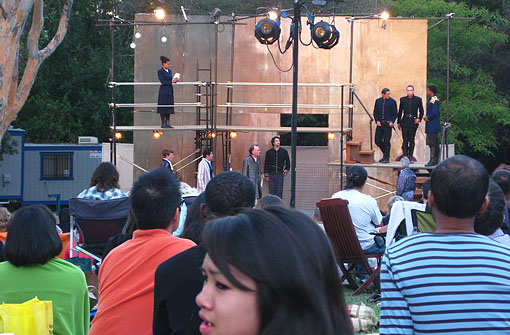 The young lady’s expression inadvertently captured in the foreground was probably unrelated to the company’s lack of projection to this distance, but it certainly mirrors the frustrations I had with such inexplicably weak voices used in an outdoor venue.
For the price of admission I suppose I shouldn’t complain, but I will: it’s patently unforgivable — especially at the final performance. I suppose fault could be placed in our laps for so naively arriving at 6 p.m. instead of, say, 6 a.m. when we could have secured and defended a space much closer to the stage and well within the range of such a rampant use of camera-ready voices. But since we weren’t alone at arriving at so far more civilized an hour I’m wondering (hoping and praying, actually) if consideration is being given either to having the director rigorously explain the art and science behind voice projection, or perhaps installing even the most rudimentary of electronic amplification systems — or even better: both!
To be sure, even from so far away I could recognize the energy and enthusiasm and talent present in the production, but if no one at the Independent Shakespeare Company either on the stage or behind it recognizes that the importance of being heard at such a venue is far more than the importance of being earnest, I’m afraid the flood of patrons fleeing from the rear at future intermissions will continue with many never to be seen again.
My wife and I among them.
Sincerely,
Will Campbell
How now? Good sir David Melville, the managing director of the company saw fit to take good and surly issue in a reply to my email (to which I parry with my reply afterward).
He writes:
My goodness what an insulting email.
Why on earth didn’t you move closer if you were having difficulty hearing? If you arrived at 6pm then you certainly could have found a better seat. There were plenty of good spots closer to the stage last night even with over 600 people in the audience. I stood at the back last night behind everyone and had a brief conversation with a patron who was amazed at the good acoustics and the skill of our actors. I’m sorry this was not your experience.
I take great exception to your comments about our actors. This is most decidedly not the prevailing attitude to our work.
Thank youDavid
And my reply to his reply:
Hi David,
My goodness what a speedy and ultra-dismissive and defensive reply in so excellent an attempt to be as insulting as you deem me to be. Had I any idea I was contacting such an easily offended and myopically over-protective representative of the company I would have dispelled with anything resembling constructive cordiality and just gone straight to the expletives.
But I’ll hold off on those pending the tone of any follow-up reply you might feel is required.
As to your ridiculously inconsiderate suggestion that we relocate further up, rest assured, had there been the opportunity to do so once the show started we certainly could have been even bigger asses than you presume us to be and packed up our low-backed lawn chairs, food, drinks and other materials and gone “excuse me, pardon me” trudging through the densely packed patrons in front of us to clatteringly unpack and resettle and better disturb their enjoyment — something you no doubt wouldn’t hesitate to do.
But shame on us for being respectful of our fellow attendees and for not being entirely accepting of those weak-voiced members of your apparently unimpeachable cast. For what it’s worth I didn’t hold every single player accountable. For instance, the fine actor portraying Cassio was as wonderfully audible as he was talented.
Anyway, I’m thrilled for you finding a guest in the back who represented that “prevailing attitude” to your work by reinforcing how everything was just peachy. Conversely, I’m embarrassed for you that you so readily disregard this guest who had a far different experience — and the truth is you’re not sorry in the slightest about it.
If nothing else you’ve reminded me that making suggestions that could be beneficial in improving an experience for everyone sometimes falls on deaf ears — ha! But at least in doing so you’re patronizing reply has provided me ample reason never to waste even a moment considering patronizing any future productions the ISC might be involved in. For that, I thank you.
Sincerely,
Will
UPDATE (12:30 p.m.): In the meantime I hear back from the far more reasonable Melissa Chalsma, ISC artistic director:
Hi Will,
Thanks for your input. I would say that your experience, on the whole, isn’t the norm, though that certainly doesn’t invalidate it. Many of the actors you saw are among the best trained in the country, and none are camera actors, having performed on Broadway, Ashland, Utah Shakespearean, Festival, etc. So, for the most part, it is the acoustics of outdoor theater, not their ability, that is the challenge.
Acoustically, it’s difficult not to have a back wall behind the audience not to bounce sound off. Any theater with 600 people generally has something to bounce the sound off of, and perhaps we will be able to do so someday, though the finances of that are decidedly challenging. Overall, though, it’s good to be a victim of our success. I’d ask you to remember, we are doing this without significant city support, and will provide free, professional theater for nearly 15,000 this summer.
If you return, please ask one of our volunteer ushers help you secure a spot closer to the stage.
Thanks again,
Melissa
To which I return:
Dear Melissa,
I had braced myself for a reply whose tone mirrored Mr. Melville’s initial response, and it’s a relief to get one featuring far more consideration than he could manage. I can appreciate that my experience might be in the minority, and as I stated in my initial email even though I couldn’t hear much of it, I could readily see that there was talent and commitment all over that stage. That in part is what made last night so frustrating.
Melville blamed us for not packing up and muscling our way during the performance to a patch of grass closer to the stage. Sorry, but that’s not how I was brought up.
I do apologize for my sarcastic reference to “camera-ready actors,” which unfortunately theater in Los Angeles has occasion to suffer from because it’s the nature of a training that is focused for dialogue on soundstages rather than stages.
And while my first email [may] not seem like it, I do recognize the difficulties you face both financially and acoustically, and I do understand and applaud the great job the ISC is doing despite those hindrances to bring professional theater to the public. It’s an important reason why we came out there last night to support it.
In closing, my suggestions — any snark aside — were offered as a life-long fan of theater outdoors and in, because I always want to see it be the best that it can be.
Regards,
Will
But just as things seem to be mellowing out, Melville comes back with the coup de grace:
Well one less pompous arse in the audience is fine by [me]. Especially one that needs a hearing aid.
To which I briefly deliberate going a little wider and posting this entertaining grind on Blogging.la but I decide just to throw back to him:
Honest Mr. Melville,
In that case, I’ll see you at the next performance to make much ado about something. I’ll be easy to spot. Just look for the villain standing in one of the old bear cages with a rapier in one hand and a bullhorn in the other yelling “I CAN’T HEAR YOU!”
Best,
Will
What ho!? Nay! It lookst to me as if there might be a thaw in the ice to see. Melville writes:
That is actually quite funny. I’m beginning to like you.
Sensing an opportunity to end things on a better note, I offer my broader mind in response:
David,
I’m a sucker for a kind word. So nevermind. It’s all my deaf-assed fault.
Seriously: I can imagine how much hard work you’ve put into herding this endeavor — and probably for little reward more than the satisfaction of seeing angelenos flock to watch it happen. As vested as you are it’s understandable that you’d be so paternally protective of your productions and your actors. I hope it’s ultimately understandable that though I’m coming at it as an unvested audience member, I’m just as paternal about theater as a whole, and always want to see it be the best it can be.
As I wrote to Melissa, my suggestions ( I won’t call them simple because I’ll wager nothing is simple where these shows are concerned)Â were sincerely offered because all sarcasm and disgruntlement aside, I’d be the first one to jump up on the battlements to cheer you on for what you’ve accomplished. You interpreted what I wrote as an attack and baseless, but IÂ submitted it not as a hater but as a diehard supporter who saw room for improvement.
Certainly you could argue “Well why didn’t you just say THAT instead of all that snarky malarky? And that’s a good note worth taking.
So howsabout a truce: You go put on a fresh coat of teflon and I’ll put the rapier and bullhorn back in storage and remain hopeful that you and the ISC will continue to look for ways to make a cherishable experience even better. Deal?
Best,
Will
In fact, all’s well that ends well. Melville writes:
I like you even better.
Next time you come please let us know and we’ll save you donor seats.
Sold… As long as there are no internal organs I’ll be required to part with for the privilege.
 Follow